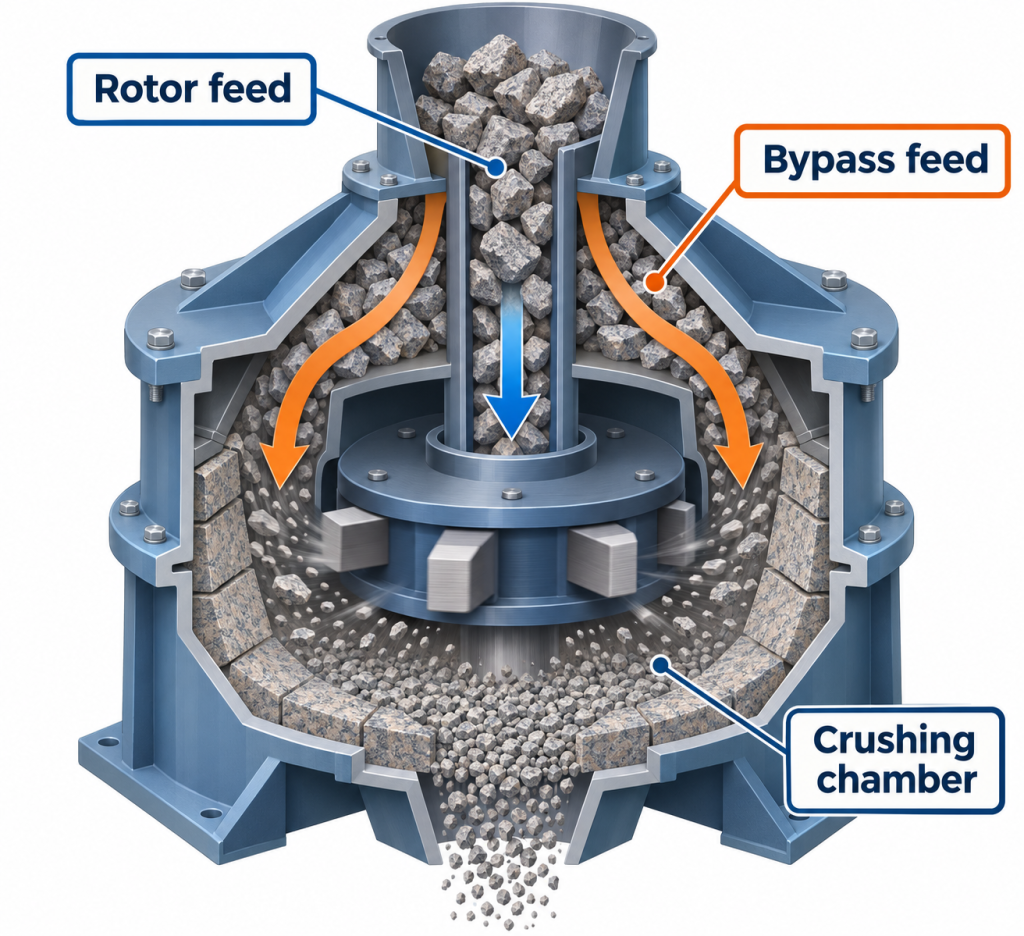
When a granite sand line misses its grading target, increasing VSI speed is only one possible response. On machines equipped with an adjustable bypass or cascade feed, the division of material between the rotor and the surrounding crushing chamber also changes the operating duty. Procurement teams therefore need a trial that evaluates saleable sand, coarse return, power demand and wear together. A higher total feed rate does not automatically mean more compliant product, and a finer discharge does not automatically justify greater operating cost. This guide explains how to define the feed envelope, compare controlled operating settings and write an acceptance basis before ordering a VSI stage. It addresses granite shaping and sand production without assuming a universal rotor speed, bypass percentage or guaranteed output.
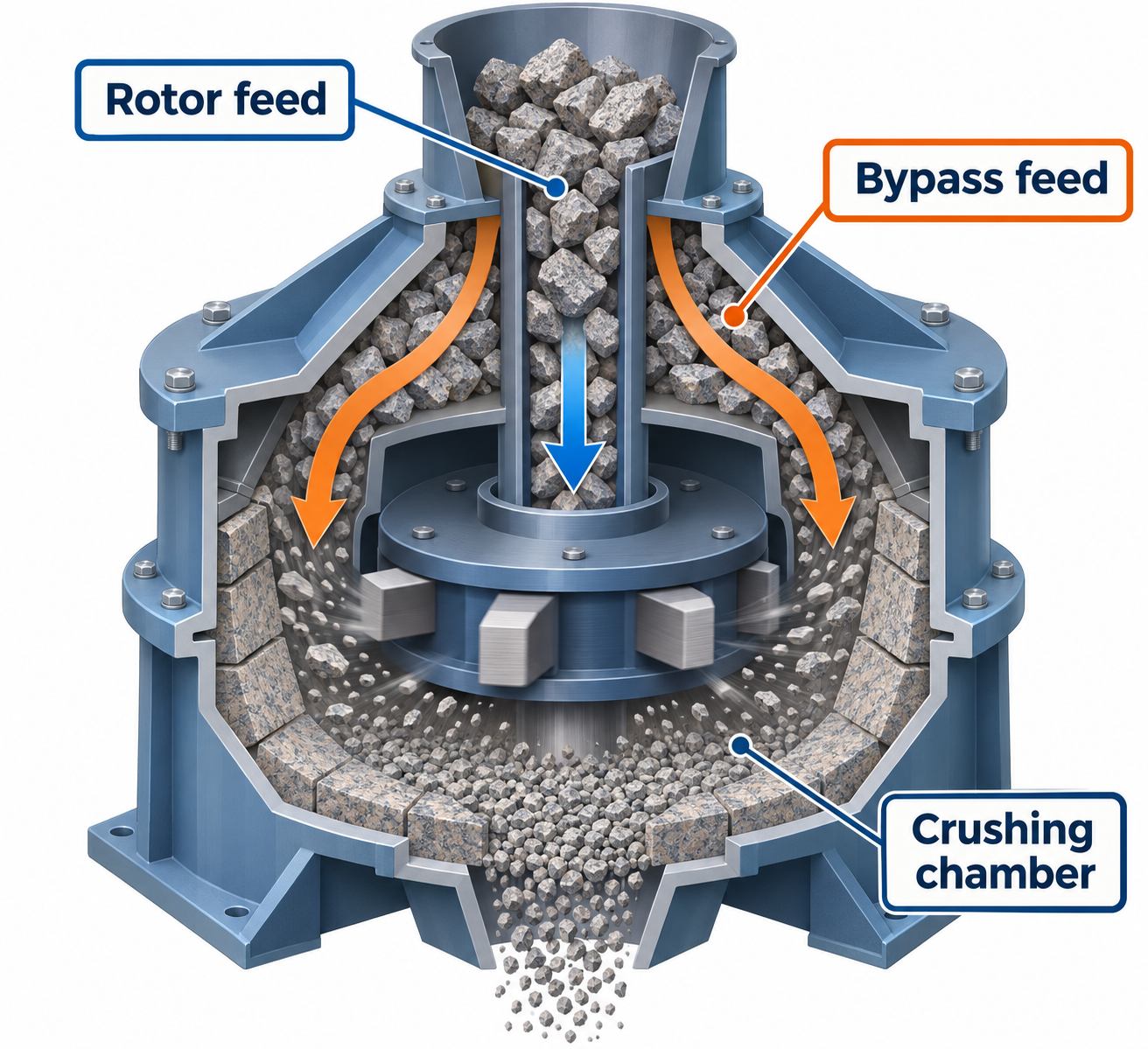
Original conceptual illustration: rotor and bypass feed paths. Actual arrangements vary by machine.
1. Define the granite feed and the saleable product
Start with representative samples from the intended VSI feed conveyor. Record particle size distribution, moisture, rock variability and the proportion already within the required product range. Distinguish fresh feed from combined fresh and circulating feed. A trial with a narrow, dry sample cannot establish performance for a plant receiving variable cone crusher discharge.
Define the sand grading envelope and the required particle shape assessment before discussing machine capacity. Include the destination of excess fines and off-specification coarse material. If several products are sold, record each separately rather than combining all discharge into one production figure. Review the available crushing and sand-making equipment against that duty and request confirmation of the permitted feed size for the exact rotor configuration.
2. Understand what the bypass adjustment changes
In a VSI with this feature, rotor-fed particles receive direct acceleration; bypass material enters the chamber without first passing through the rotor. The two streams interact in the crushing zone. Changing their split can alter throughput, size reduction and product shape, but the direction and size of the effect depend on the machine and feed. A bypass-equipped configuration must be identified explicitly in the quotation; this adjustment is not available on every VSI.
Separate the speed decision from the feed-split decision. Ask the supplier which variables can be adjusted during operation, which require shutdown, and how the split is measured or inferred. A gate position alone may not establish the actual mass split when feed properties change. Do not transfer settings from another rotor diameter or rock type.
3. Compare settings with a controlled trial matrix
Agree a baseline within the manufacturer’s operating limits, then change one variable at a time. Keep the feed source, sampling method and downstream screen arrangement comparable. Allow the circuit to stabilize before collecting synchronized feed and product samples. Record interruptions and exclude unstable periods from a steady-state comparison while retaining them in the reliability record.
| Trial condition | Hold comparable | Inspect before accepting |
|---|---|---|
| Baseline rotor speed and feed split | Granite feed grading and moisture | Product grading, shape and mass balance |
| Adjusted bypass at the same speed | Feed source and sampling basis | Saleable sand output versus coarse return |
| Adjusted speed at the selected split | Feed envelope and product specification | Power demand, fines generation and wear exposure |
| Representative variable-feed run | Agreed control logic and operating limits | Recovery from feed changes and off-specification production |
Measure saleable output after classification. Calculate energy per tonne of compliant product using a clearly stated electrical boundary, such as the VSI alone or the complete test circuit. Keep those boundaries consistent across bids. Short trials can compare grading and power; they cannot establish a dependable long-term wear cost without supporting service evidence.
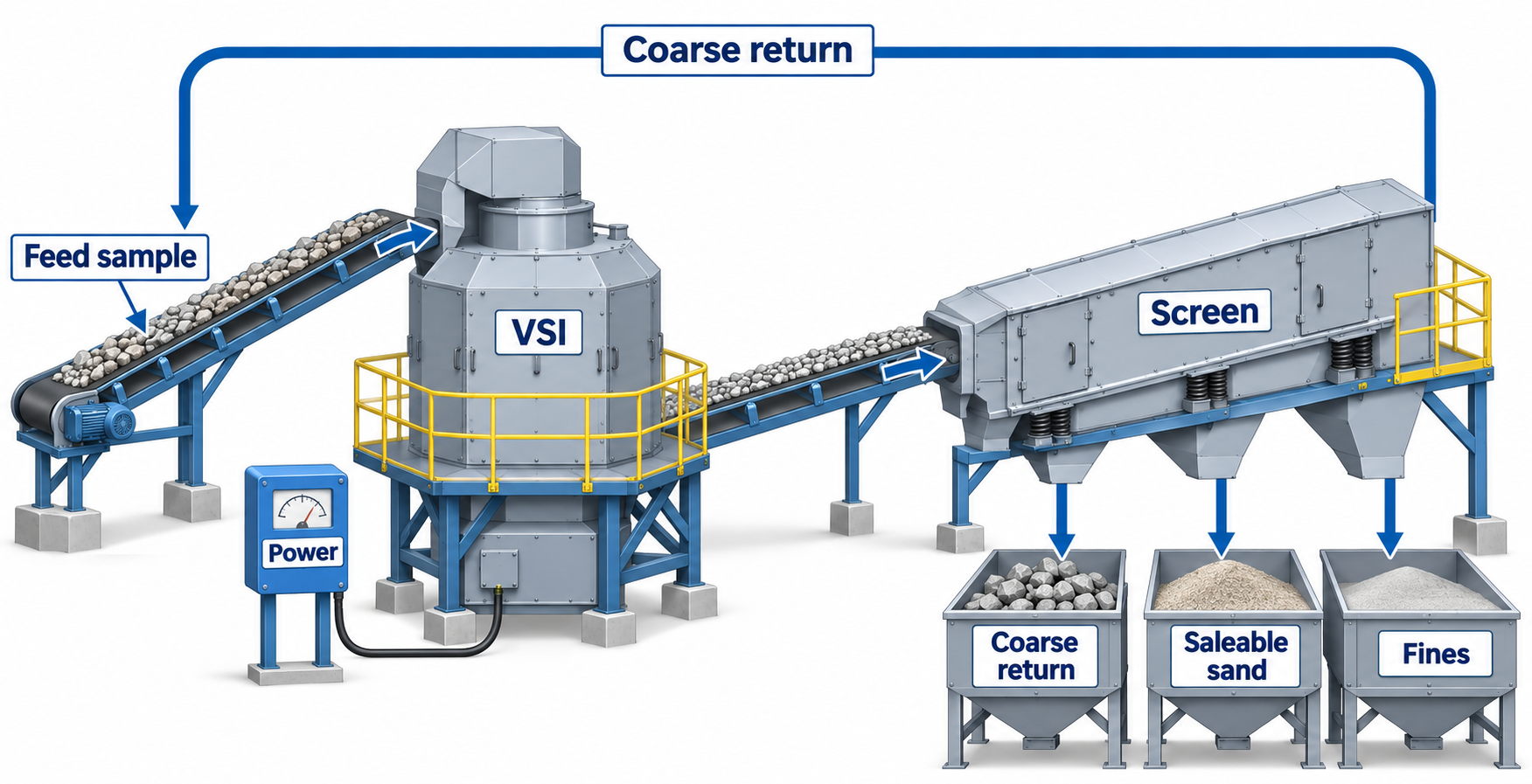
Original trial-planning illustration: compare feed, classified products and measured power on the same sampling basis.
4. Check the screen and return circuit before selecting the setting
The VSI discharge is an intermediate stream in a closed circuit. A setting that increases coarse material can raise the return load and consume conveyor or screen capacity. Conversely, excess fines may create a product handling problem even when the sand fraction rises. Sample screen products and return material together so that an apparent crusher improvement is not simply a change in screen separation.
Check the receiving equipment for the highest credible circulating duty, including transfer chutes and surge storage. Request the expected stream balance for each proposed operating mode. If the upstream feed is unstable, resolve that variability before treating the trial as proof of a particular feed split. Make provision for safe, representative sampling without opening running equipment or removing guards.
5. Write an acceptance basis around compliant sand
Specify the granite feed envelope, product test methods, sampling locations, trial duration and treatment of off-specification production in the purchase documents. Require reported fresh feed, total VSI feed, saleable products and return load to reconcile within an agreed measurement tolerance. Set contractual limits only after reviewing representative test evidence; this guide supplies no universal capacity or energy guarantee.
Include the rotor and chamber configuration, adjustment method, installed drive, wear-part access, spare parts and shutdown requirements in the scope. Ask for separate evidence supporting wear-life assumptions. Send the feed analysis and proposed product specification with your VSI application enquiry so the supplier can propose a testable configuration. Select the setting that consistently meets the agreed product and circuit requirements, then assess its operating cost on that same basis.
mj
Author & industry specialist at ZWCC Mining & Crushing