Project Overview
Many copper mine operators in Zambia struggle to select matching crushing machines, facing frequent equipment blockages, high power consumption, inconsistent ore particle sizes and poor downstream flotation recovery. Zambia’s Copperbelt region holds sediment-hosted copper-cobalt ore with mixed sulfide and oxide layers, fluctuating seasonal moisture, unstable national power supply and strict local environmental management rules. This article breaks down local mining pain points, provides targeted multi-stage crushing configurations for Zambian copper ore, lists climate & power-adapted machine upgrades, and answers common selection questions to help investors pick cost-effective, site-fit crushing equipment.
Core Crushing Pain Points for Zambian Copper Mines
1.1 Ore property related failures
Most Zambian copper ore carries 12–16 Mohs hard silica gangue and variable clay content. During rainy seasons (November–April), wet clay ore easily clogs crushing cavities, causing machine stalling and 20%–30% throughput drop. Oxide copper ore has loose texture while sulfide copper rock is highly abrasive; standard liners wear out 2–3 times faster than ordinary stone crushing conditions, pushing up daily maintenance costs.
1.2 Regional power & site constraints
Zambia relies heavily on hydropower, with severe power shortages in dry seasons, forcing frequent load shedding that halts fixed crushing lines. Remote open-pit mines far from the Copperbelt main grid lack stable high-voltage electricity, and long-distance ore haulage increases fuel expenditure. Many small-scale mines have limited flat land for large fixed crushing foundations, delaying project launch.
1.3 Local environmental compliance pressure
ZEMA (Zambia Environmental Management Agency) enforces strict dust, noise and tailings control rules. Unsealed crushing equipment generates excessive fugitive dust, leading to fines or temporary shutdowns. Traditional open-circuit crushing produces uneven particle gradation, raising tailings waste and lowering copper concentrate recovery rate.
Targeted Copper Ore Crushing Equipment Selection Solutions
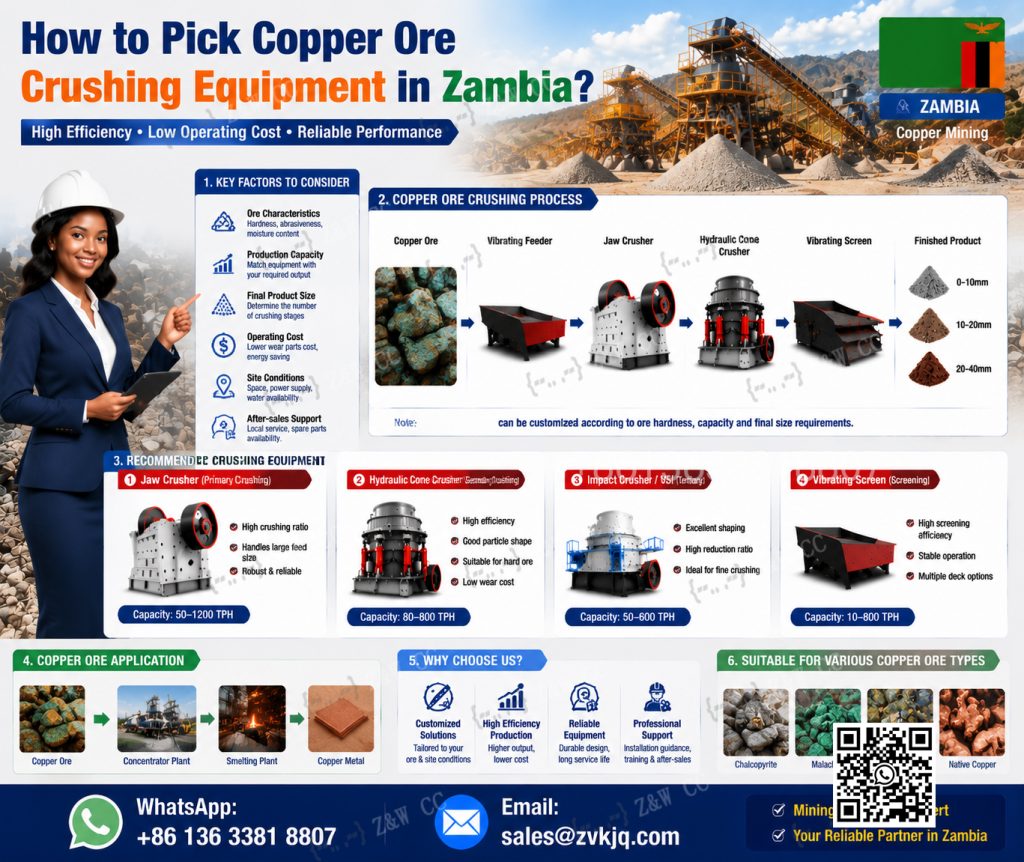
Zambian copper processing follows the “more crushing, less grinding” principle, split into two mainstream production layouts for different mine scales. Below is a comparative parameter table for fixed and mobile crushing circuits.
| Item | Fixed Two-Stage Closed Circuit (≥150t/h Large Mine) | Mobile Integrated Crushing Station (≤120t/h Small/Remote Pit) |
|---|---|---|
| Primary Crusher | Heavy-duty jaw crusher, max feed size 1000mm | Mobile jaw crushing unit, feed size ≤750mm |
| Secondary Crusher | Hydraulic cone crusher (medium-fine crushing) | Wheel-mounted cone crusher, integrated screening |
| Final Discharge Size | 8–20mm, stable for ball mill feeding | 10–25mm, flexible adjustment for temporary stockpiles |
| Power Adaptation | Matched with 330kV Copperbelt grid, supports auxiliary solar power | Equipped with standby diesel generator module for off-grid sites |
| Foundation Cost | High concrete civil construction | Zero heavy foundation, fast on-site deployment within 3 days |
| Suitable Scenario | Centralized large open-pit mines in Kitwe, Ndola | Scattered small pits, remote mining zones without power grid |
2.1 Primary Crushing Stage: Jaw Crusher Selection Guide
For Zambian raw copper ore chunks over 600mm, jaw crushers are the only viable primary crushing option. Prioritize models with thick manganese alloy tooth plates to resist silica abrasion.
- Large mines (200–400t/h): PEW series heavy jaw crusher, with anti-blockage hopper design to handle rainy-season muddy ore.
- Small mines (50–100t/h): Compact jaw units with simplified lubrication system, reducing daily maintenance manpower in remote sites.
2.2 Secondary & Tertiary Crushing: Hydraulic Cone Crusher (Exclusive for Copper Ore)
Avoid impact crushers for Zambian hard sulfide copper ore—their blow bars wear too rapidly. Single-cylinder hydraulic cone crushers work best for medium crushing, while multi-cylinder cone crushers finish fine crushing to uniform particles for flotation feed.
Key customized upgrades for Zambia:
- Wider discharge cavity to prevent clay ore packing during wet seasons;
- Automatic overload protection to avoid damage during sudden hard rock surges;
- Low-power energy-saving eccentric design to cut electricity consumption by 12%–18% amid national power limits.
2.3 Supporting Auxiliary Equipment Matching
- Vibrating feeder: With grid pre-scalping to filter fine clay waste before crushing, reducing cavity blockage risk;
- Circular vibrating screen: Closed-circuit screening to return oversize ore back to cone crusher, guaranteeing consistent feed for grinding;
- Fully sealed dust cover + water spray dedusting system: Meet ZEMA dust emission standards without extra large wastewater treatment tanks.
2.4 Difference Between Copper Ore & Aggregate Stone Crushing Lines
Copper crushing targets mineral dissociation for flotation, requiring narrow, stable particle distribution (8–20mm). Sand & aggregate production prioritizes cubic finished stones with wider size ranges. Copper circuits must add anti-abrasion liner parts and closed-circuit screening, while stone lines use impact crushers for shaping—never interchange equipment between the two processes.
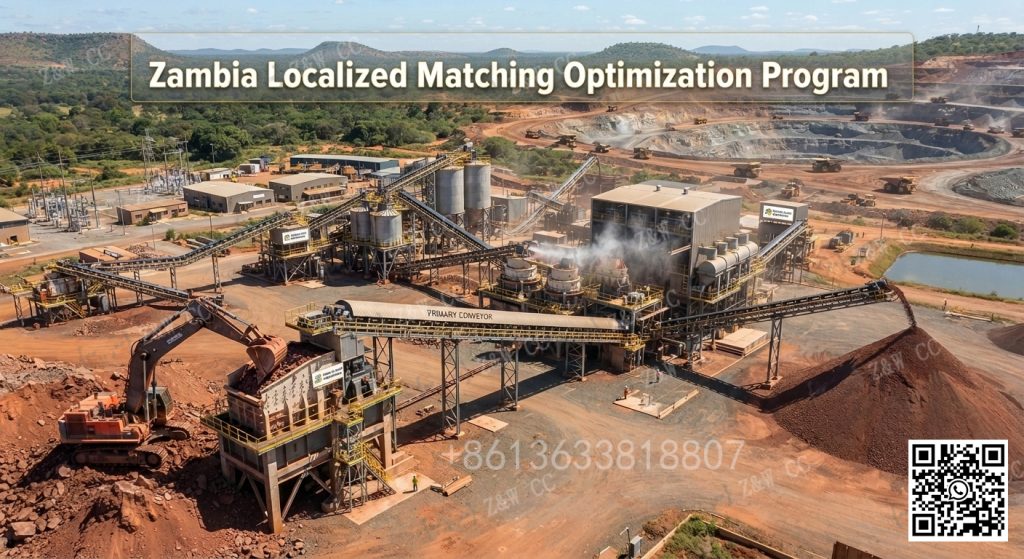
Zambia Localized Matching Optimization Program
3.1 Tropical Seasonal Climate Adaptation
Rainy season upgrade: All electrical motors adopt IP65 waterproof casing; conveyor belts add anti-slip anti-clay coating to avoid material slipping. Dry season high-temperature protection: Crusher lubrication system installs independent cooling radiators to prevent oil breakdown under 30℃+ ambient heat.
3.2 Power Supply Compatibility Design
- Grid-connected fixed plants: Configure power buffer cabinets to stabilize voltage fluctuations during peak-hour load shedding; reserve space for solar power access to cut grid electricity reliance.
- Off-grid remote mines: Mobile crushing stations integrate silent diesel generators, with fuel storage frames compatible with local bulk fuel delivery trucks.
3.3 Transportation & After-sales Adaptation
All core crusher spare parts (jaw plates, cone liners) are split into modular small packages for cross-border road transport to Copperbelt provinces. Local technical service warehouses store common wear parts to shorten replacement downtime within 48 hours.
4. FAQ for Copper Ore Crusher Selection in Zambia
Q1: Can I use impact crushers for Zambian sulfide copper ore crushing?
A: Not recommended. Sulfide copper ore contains high hard silica gangue, impact crusher blow bars wear out in 1–2 weeks, raising long-term operation costs. Hydraulic cone crushers deliver 3–5 times longer liner service life for hard copper rock.
Q2: What crushing layout fits small remote mines without stable power grids in Northwestern Zambia?
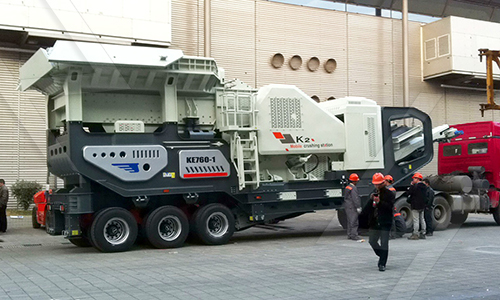
A: Wheel-type mobile jaw + cone integrated crushing station with built-in diesel generator. No fixed foundation required, can shift between scattered mining zones, and works independently without grid electricity.
Q3: How to reduce rainy-season clay ore blockage in Zambian copper crushing lines?
A: Add pre-scalping vibrating feeder before primary jaw crusher to sieve sticky fine clay; select cone crushers with enlarged lower crushing cavity, and install high-pressure water spray devices on feeding hoppers.
Q4: How to match crushing equipment to meet ZEMA environmental regulations?
A: Choose fully enclosed crushing frame + centralized dust removal system; equip low-noise motor and vibration damping base to control noise below 85dB, and build dry tailings stacking area to avoid river water pollution.
Conclusion & CTA
Selecting copper ore crushing equipment in Zambia must balance local ore hardness, tropical seasonal climate, unstable power supply and environmental laws. Large centralized Copperbelt mines adopt two-stage closed-circuit fixed jaw-cone crushing lines for high stable throughput; scattered small remote pits pick mobile integrated crushing stations to cut civil construction and haulage costs.
If you need customized copper crushing line layout drawings, detailed hourly capacity parameter sheets or accurate project budget quotations tailored to your Zambia mine ore grade and site conditions, contact our professional mining technical consultants via online chat on the right side for one-stop tailored solutions.
.jpg)
.jpg)