Selecting the right crusher for manganese ore magnetic separation in the Democratic Republic of Congo (DRC) requires balancing ore hardness, beneficiation efficiency, and remote-site constraints. The DRC hosts significant manganese deposits across the Katanga copperbelt region, yet operators face unreliable grid power, extended rainy seasons, and limited road access to mining sites. This article outlines key equipment selection criteria, compares suitable crusher models, and addresses local adaptation strategies for DRC manganese processing projects.
DRC Manganese Ore Processing: Key Challenges
- Ore variability — Manganese minerals in DRC deposits range from pyrolusite (Mohs 5-6) to softer psilomelane (3-4), requiring crushers that handle mixed hardness feed.
- Remote site power — Many DRC manganese concessions lack grid connectivity, forcing reliance on diesel generators sized for continuous crusher operation.
- Tropical humidity — High ambient humidity and heavy rainfall (Oct–May in southern Katanga) increase moisture in feed ore, affecting screening efficiency and magnetic separator performance.
- Transport infrastructure — Poor road conditions between mining sites and export corridors via Durban or Dar es Salaam complicate heavy equipment delivery and wear-parts resupply.
Optimized Crusher Selection for DRC Manganese Magnetic Separation
Multi-Stage Crushing Configuration
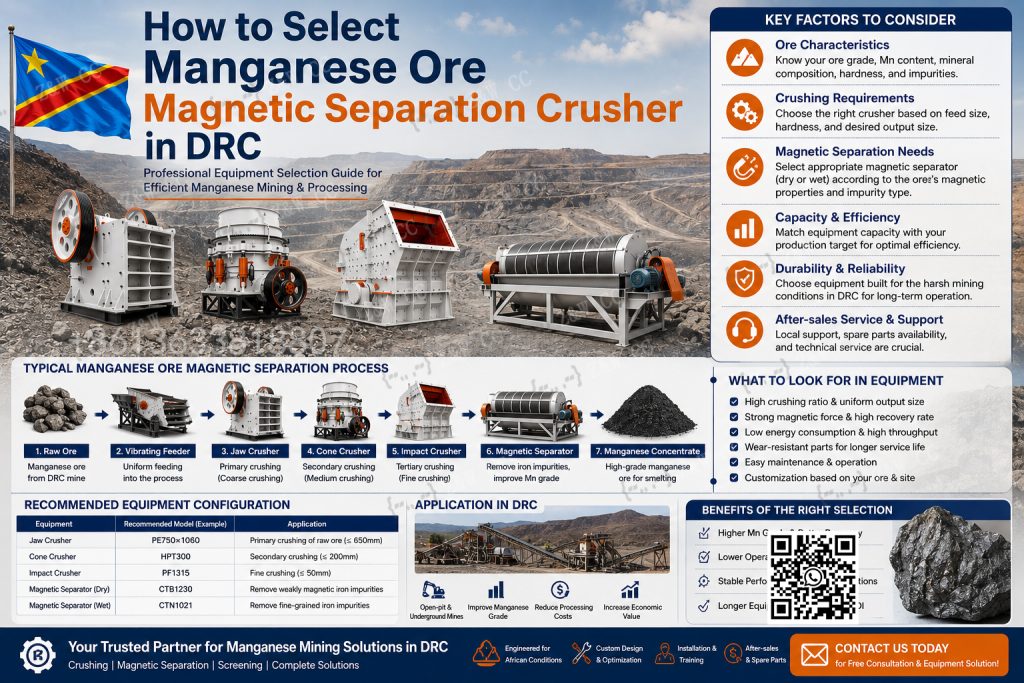
Manganese ore is a metal ore requiring liberation before magnetic separation. A typical DRC flow uses primary jaw crushing → secondary cone crushing → grinding → wet high-intensity magnetic separation (WHIMS). Unlike aggregate processing (jaw → cone → VSI → screening), the goal here is achieving liberation at 0.1-5 mm while minimizing over-grinding that reduces magnetic recovery. For harder manganese oxides, a jaw-cone combination handles compressive strengths up to 200 MPa; for softer carbonate ores, jaw-impact configurations reduce wear cost.
Equipment Comparison: Two Configuration Options
| Parameter | Option A: Jaw + Cone | Option B: Jaw + Impact |
|---|---|---|
| Suitable ore | Hard oxide Mn (Mohs 5-6) | Soft carbonate Mn (Mohs 3-4) |
| Capacity (tph) | 100-500 | 50-300 |
| Max feed (mm) | ≤750 | ≤500 |
| Discharge (mm) | 10-40 | 10-40 |
| Power (kW) | 110-250 | 75-160 |
| Wear cost | Medium (mantle/bowl liner) | Higher (blow bars in abrasive feed) |
Magnetic Separation Integration
After crushing and grinding, DRC manganese ore typically undergoes wet high-intensity magnetic separation at field strengths of 8,000-15,000 Gauss. The crusher discharge PSD directly affects liberation and recovery — a well-controlled 10-40 mm secondary discharge ensures efficient ball mill feed and consistent separator performance. Pre-screening with vibrating screens removes fines that would otherwise short-circuit magnetic separation circuits.
Local Adaptation for DRC Operations
DRC manganese sites require equipment rated for tropical conditions: IP55-rated electrical panels with anti-condensation heaters, hot-dip galvanized or epoxy-coated steel frames for corrosion resistance, and diesel-generator power packages sized at 1.3-1.5× rated crusher motor load to handle voltage dips. The DRC Mining Code mandates environmental impact assessments and water management plans — closed-loop water systems with thickeners and filter presses address zero-discharge requirements while conserving water during the dry season. Road transport constraints mean modular crusher designs that fit standard 40-foot containers reduce logistics cost to remote Katanga concessions.
Frequently Asked Questions
What crusher type is best for hard manganese oxide ore in DRC?
A jaw crusher for primary stage followed by a cone crusher for secondary stage suits hard manganese oxide ore (Mohs 5-6), providing reliable reduction with manageable wear costs in remote DRC sites.
How does DRC’s tropical climate affect manganese magnetic separation?
High humidity increases ore moisture, which can reduce screening efficiency and cause slurry viscosity issues in wet magnetic separators. Enclosed screens and proper thickener sizing mitigate these effects.
What power capacity is needed for a DRC manganese crushing plant?
A 100-200 tph manganese crushing line typically requires 200-400 kW total installed power. Diesel generators should be oversized by 30-50% to handle startup surges and voltage fluctuations common on DRC sites.
Can the same crusher handle both manganese and copper ore in DRC?
Yes, jaw and cone crushers can process both ores, but manganese liberation requires finer grinding (0.1-5 mm) before magnetic separation, whereas copper sulfide ore needs flotation at 0.05-0.15 mm.
Get Your Custom Manganese Processing Solution
Selecting the right crusher for DRC manganese magnetic separation depends on ore mineralogy, site power conditions, and transport logistics. Our engineering team provides tailored production line proposals, equipment layout drawings, and project quotations based on your specific deposit characteristics. Click the online consultation widget on the right for immediate technical support and a customized equipment list.
zmj
Author & industry specialist at ZWCC Mining & Crushing