Stationary Crushing Line for Limestone in Egypt: Configuration & Equipment Guide
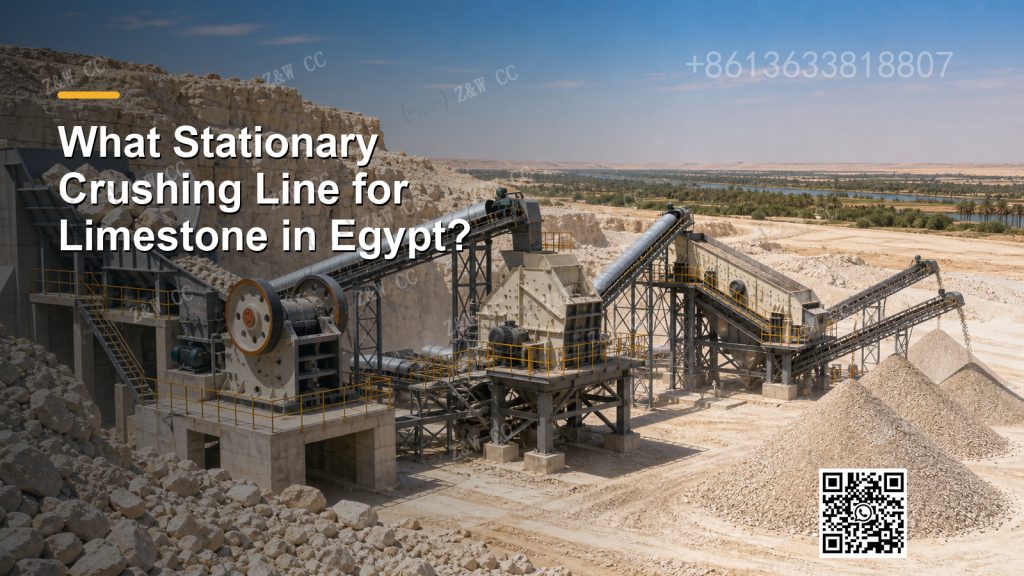
Egyptian quarry operators searching for a stationary crushing line for limestone often face challenges with high summer temperatures, dust control regulations, and fluctuating power supply in remote desert sites. Limestone deposits in the Nile Valley and Sinai regions support growing construction and cement industries. This article outlines the key equipment configuration, process flow, and local adaptation measures for a stationary limestone crushing plant built for Egyptian conditions.
Egypt Limestone Crushing: Key Challenges
- Summer temperatures reaching 40-50°C in quarry zones, requiring heat-resistant motors and enhanced cooling systems
- Egyptian Environmental Law No. 4 of 1994 mandates strict dust emission limits, demanding enclosed crushing and baghouse filtration
- Remote desert quarries often lack stable grid power, necessitating diesel-generator backup or hybrid power configurations
- Limestone in Sinai and Eastern Desert zones varies in silica content, affecting crusher wear life and product gradation
Optimized Stationary Crushing Configuration for Egypt
Two-Stage vs. Three-Stage Crushing for Limestone
For limestone (Mohs 3-4, compressive strength 60-170 MPa, low-medium abrasiveness), a two-stage configuration of jaw crusher plus impact crusher is typically sufficient for aggregate production. A three-stage design adding a VSI sand maker is recommended when manufactured sand output is also required.
| Parameter | Two-Stage (Jaw + Impact) | Three-Stage (Jaw + Impact + VSI) |
|---|---|---|
| Capacity (tph) | 100-500 | 150-600 |
| Max feed size (mm) | ≤500 | ≤600 |
| Final product (mm) | 5-40 | 0-5 (sand) to 40 |
| Power consumption (kWh/t) | 0.8-1.2 | 1.0-1.5 |
| Relative investment | Lower | 30-40% higher |
Recommended Process Flow
ROM limestone → vibrating feeder → primary jaw crusher (PE-600×900 or PE-900×1200) → vibrating screen → oversize to secondary impact crusher (PF-1214 or PF-1320) → return to screen → size-graded aggregate stockpiles. For manufactured sand, add a VSI sand maker (VSI-8518 or VSI-9526) after the fines fraction, followed by sand washing and dewatering screens.
Aggregate vs. Metal Ore Distinction
Egyptian limestone is processed primarily as construction aggregate and cement raw material — not metal ore. The flow emphasizes gradation control, flakiness index (<15%), and fines content (<10%), rather than mineral liberation or beneficiation circuits.
Local Adaptation for Egypt
For 40-50°C summer conditions, specify motors with F-class insulation and oversized cooling fans. Compliance with Egyptian Environmental Law No. 4 of 1994 requires pulse-jet baghouse dust collectors at crusher discharge points, achieving PM10 emissions below 50 mg/Nm³. Remote desert sites benefit from diesel-generator sets sized at 1.3× the plant’s total connected power. Transport via the Cairo–Suez highway corridor allows standard truck loading, but desert quarry roads may require extended conveyor systems instead of long-haul trucking.
Frequently Asked Questions
What is the best stationary crusher for limestone in Egypt?
A jaw crusher for primary crushing paired with an impact crusher for secondary reduction suits Egyptian limestone (Mohs 3-4) well, offering low wear cost and good particle shape for aggregate production.
How much does a stationary limestone crushing line cost in Egypt?
A 200-300 tph stationary limestone plant typically ranges from $80,000 to $250,000, depending on configuration, brand selection, and whether sand-making and washing modules are included.
What capacity stationary crushing line suits Egyptian limestone quarries?
Most Egyptian limestone quarries operate at 150-400 tph, with large cement-grade operations reaching 500-800 tph. Capacity selection depends on deposit size and downstream market demand.
How to control dust in a stationary limestone plant in Egypt?
Install pulse-jet baghouse collectors at crusher discharge and transfer points, enclose conveyor belts, and use water misting at the primary feed hopper. This combination meets Egyptian Law No. 4 of 1994 emission limits.
Get Your Custom Limestone Crushing Solution
Selecting the right stationary crushing line for Egyptian limestone depends on your deposit characteristics, target product mix, and site conditions. Contact our engineering team for a tailored plant proposal, equipment layout drawings, and itemized quotation. Click the online consultation widget on the right for immediate technical support and project feasibility analysis.
zmj
Author & industry specialist at ZWCC Mining & Crushing
.jpg)