Project Overview
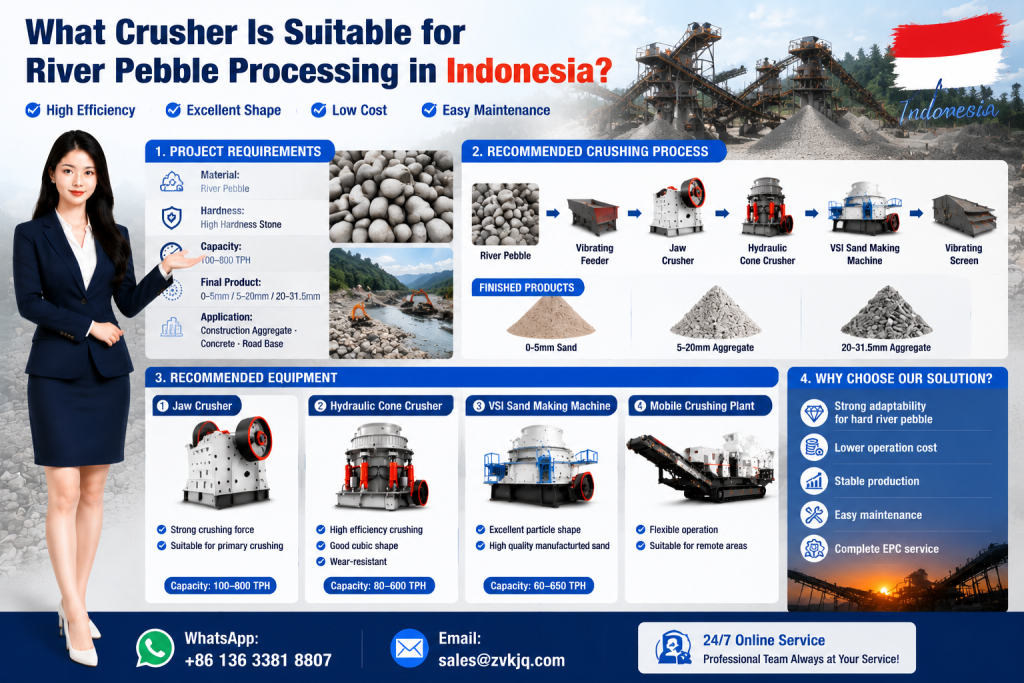
Many aggregate investors in Indonesia search for the right crusher to process local river pebbles, struggling with mismatched crushing equipment, high wear loss, strict tropical environmental rules, and scattered river deposit distribution across Java, Kalimantan and Sulawesi. Indonesian river pebbles feature high hardness (110–180 MPa), round smooth textures and 4%–8% natural moisture under year-round hot humid monsoon weather. This article breaks down core operational pain points, delivers targeted crusher selection & complete pebble crushing processes, lists Indonesia-specific customized upgrades, answers common industry questions, and provides actionable production line solutions for small, medium and large river pebble quarries.
Core Pain Points of River Pebble Production in Indonesia
1. Material & Climate Wear Challenge
Indonesian river pebbles contain high silica content, leading to fast abrasion of impact crusher blow bars. Constant 30–38°C tropical heat plus seasonal heavy rain accelerates rust on unprotected machine frames, while wet raw materials easily block crushing cavities and screening decks during rainy seasons.
2. Strict Local Environmental Compliance
Regulation GR 22/2021 and MOE Reg. 20/2025 mandate closed dust collection, sediment recycling, and post-mining land reclamation for all river aggregate projects. Open crushing lines without dust suppression face heavy fines or temporary shutdowns; wastewater from pebble washing cannot discharge directly into river systems.
3. Uneven Infrastructure & Power Supply
Main Java regions have stable grid power, while remote river mining zones in outer islands suffer frequent power cuts and high industrial electricity costs. Rural access roads have weight limits, making large fixed crushing plants hard to transport raw pebbles over long distances.
4. Scattered River Pebble Deposits
Most Indonesian river gravel resources spread along riverbanks instead of centralized quarries. Building full fixed foundations for every small deposit generates excessive civil engineering costs, and short mining cycles make stationary lines low ROI.
Targeted Crusher & Complete River Pebble Crushing Solutions
River pebble processing differs greatly from metal ore beneficiation: metal mines require magnetic separation, flotation and tailings stacking, while pebble production only needs three-stage crushing, screening and sand washing to produce construction aggregates. Below are classified crusher options matched with production capacity.
1. Primary Coarse Crushing: Jaw Crusher (Mandatory for All Scales)
Jaw crushers handle raw river pebbles with feed size up to 500mm, delivering stable coarse crushing for hard siliceous pebbles.
- Small capacity (20–80 TPH): PE600×900 jaw crusher, low power consumption, fits small family river gravel yards
- Medium capacity (100–300 TPH): JC European version jaw crusher, hydraulic discharge adjustment, anti-rust thickened frame for humid Indonesia climate
- Large capacity (350–800 TPH): PE1200×1500 heavy jaw crusher, heavy-duty manganese jaw plates to cut wear replacement frequency
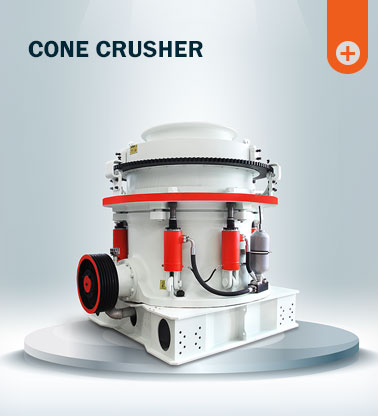
2. Secondary Medium & Fine Crushing: Cone Crusher (Optimal for River Pebbles)
Impact crushers are not recommended as main medium crushers for Indonesia pebbles due to ultra-high wear costs. Multi-cylinder hydraulic cone crushers stand as the standard secondary unit for hard river stone:
- Single-cylinder cone: For 80–200 TPH small-medium lines, simple maintenance, low spare part cost
- Multi-cylinder hydraulic cone: For 250–800 TPH large plants, uniform particle shape, less needle-like aggregate, automatic overload protection to avoid blockage in rainy wet material conditions
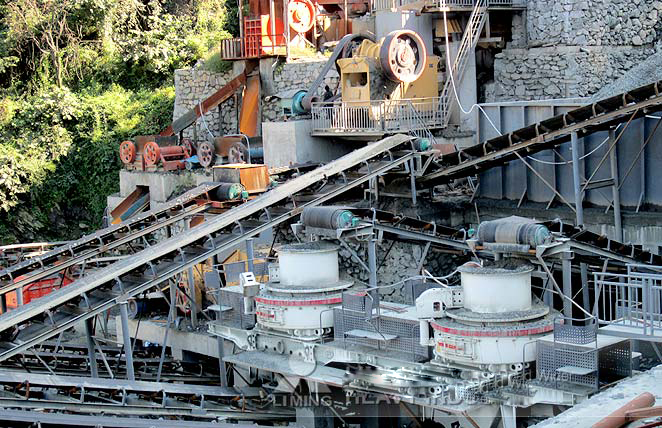
3. Tertiary Sand Making: VSI Vertical Shaft Impact Crusher
After cone medium crushing, VSI sand maker adopts stone-on-stone crushing mode to shape round pebbles into standard 0–5mm manufactured sand meeting Indonesian concrete aggregate standards. Equipped with wet dust sealing to resist tropical humidity corrosion.
Fixed vs Mobile Crushing Station Comparison Table for Indonesia River Pebble
| Comparison Item | Fixed River Pebble Crushing Line | Mobile Tracked Crushing Plant |
|---|---|---|
| Applicable Scene | Centralized large river deposit, Java stable power area | Scattered outer-island river sites, short mining cycle |
| Civil Investment | High, concrete foundation, drainage system required | Zero fixed foundation, direct deployment on riverbank |
| Power Adaptation | Only grid electricity supported | Dual power: grid + diesel generator for remote zones |
| Transfer Cost | High heavy haulage, disassembly & reinstall labor cost | Self-driving track chassis, 30-minute relocation |
| Labor Demand | 4–5 workers per shift | 2 operators per shift |
| Typical Capacity | 150–800 TPH | 30–250 TPH |
| Environmental Matching | Easy to install full closed dust & water circulation | Compact integrated dust suppression system |
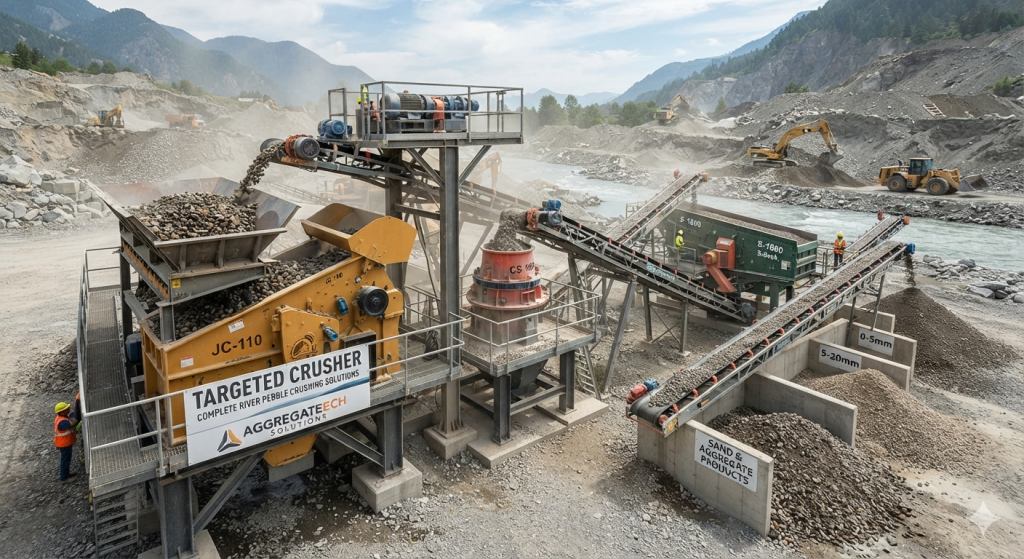
Standard 3-Stage River Pebble Process Flow for Indonesia
- Feeding: ZSW vibrating feeder pre-screens mud and fine sand from wet raw pebbles to prevent blockage
- Coarse crushing: Jaw crusher breaks large pebbles into 50–120mm medium stones
- Medium crushing: Cone crusher processes materials into 10–50mm semi-finished aggregate
- Sand making: VSI impact crusher shapes fine sand
- Screening & washing: Multi-layer vibrating screen + sand washer, closed wastewater circulation tank to comply with river protection rules
- Closed loop: Oversized materials return to cone crusher for re-crushing, raw material utilization ≥97%
Indonesia Localized Customized Matching Design
1. Humid Tropical Climate Adaptation
- All motor, bearing and electrical cabinets adopt IP65 waterproof & dustproof grade to resist rain and high air moisture
- Machine frame sprayed with double-layer anti-corrosion marine paint to extend service life by 30% under coastal river environment
- Vibration screen deck equipped with anti-clogging rubber sieve mesh for rainy-season wet pebbles
2. Power & Transport Optimization
- Mobile crushing units fitted with low-fuel-consumption diesel generators for Kalimantan/Sulawesi off-grid river sites
- Fixed lines reserved dual power interface to switch between grid and temporary generators during power outages
- Modular split design for large fixed equipment, matching Indonesia highway truck weight limits to reduce transport surcharges
3. Local Environmental Regulation Matching
- Full pulse bag dust collector covering all crushing & screening points to meet AMDAL environmental approval standards
- Closed water circulation tank for sand washing, zero direct river discharge, sediment recycling as low-grade filling aggregate
- Low-noise sealed conveyor covers to avoid noise complaints near residential river villages
FAQ for Indonesia River Pebble Crushing
Q1: Can impact crushers replace cone crushers for hard Indonesian river pebbles?
A1: Not recommended for long-term production. High silica pebbles wear impact blow bars severely, spare part replacement cycle shortens to 7–10 days, raising daily operation cost by over 40%. Cone crushers have 3–6 month liner service life, more economical for local hard river stone.
Q2: Which crusher is better for small scattered river gravel yards in Sulawesi?
A2: Tracked mobile jaw + cone combined crushing station. No civil construction, self-driving to different river sections, diesel-electric dual power adapts to unstable outer island power grids, payback period within 1.5–2 years.
Q3: What aggregate specifications do Indonesian construction projects require from river pebble crushing lines?
A3: Standard finished sizes: 0–5mm manufactured sand, 5–10mm, 10–20mm, 20–40mm coarse aggregate. The production line must be equipped with 4-layer vibrating screens to separate four grades simultaneously for highway, dam and residential concrete projects.
Q4: How to adjust the crushing line to pass Indonesia’s environmental inspection?
A4: Three mandatory configurations: full closed dust removal system, circulating sediment wastewater tank, and stockpile wind-proof dust barriers. All environmental supporting equipment must be included in the initial plant layout to pass UKL-UPL environmental monitoring approval smoothly.
Conclusion & CTA
Selecting suitable crushers for Indonesian river pebbles must balance pebble hardness, local monsoon climate, scattered mining distribution and strict national environmental rules. Centralized large-scale river gravel projects on Java prioritize fixed jaw-cone-VSI three-stage lines; scattered outer-island river deposits adopt tracked mobile integrated crushing stations to cut civil and transfer costs.
If you operate a river pebble quarry in Indonesia and need capacity-matched crusher configuration drawings, detailed production cost breakdowns or factory direct quotations, contact our technical team via online consultation on the right side. Our engineers will design a fully localized river pebble crushing scheme compliant with Indonesian mining and environmental regulations free of charge.
.jpg)