Choosing a tungsten ore heavy medium crushing plant in Botswana starts with the ore itself: scheelite and wolframite are hard and abrasive, and feed grades often sit below 1% WO₃. That makes early waste rejection the single biggest lever on plant economics. Add remote Kalahari sites, scarce water, and grid power that does not reach every mine, and the selection becomes more demanding than a standard aggregate plant.
This guide compares crushing configurations, explains how heavy medium separation (HMS) fits into the tungsten flow sheet, and highlights the Botswana-specific factors that should shape your plant design.
Tungsten Ore Processing Challenges in Botswana
- Low-grade, hard ore: When ROM grade is under 1% WO₃, every tonne of barren rock sent to grinding wastes energy, media, and water.
- Water scarcity: Much of the country is semi-arid Kalahari terrain; process water must be recovered and recycled, not discharged.
- Power supply limits: Rural mines may depend on Botswana Power Corporation lines with diesel backup, so plant loads need conservative sizing.
- Long haulage routes: Gravel roads and long distances to export ports make on-site waste rejection a transport-cost issue as well.
Designing a Heavy Medium Crushing Plant for Tungsten Ore
Crushing Train: Jaw + Cone, Sized for Liberation
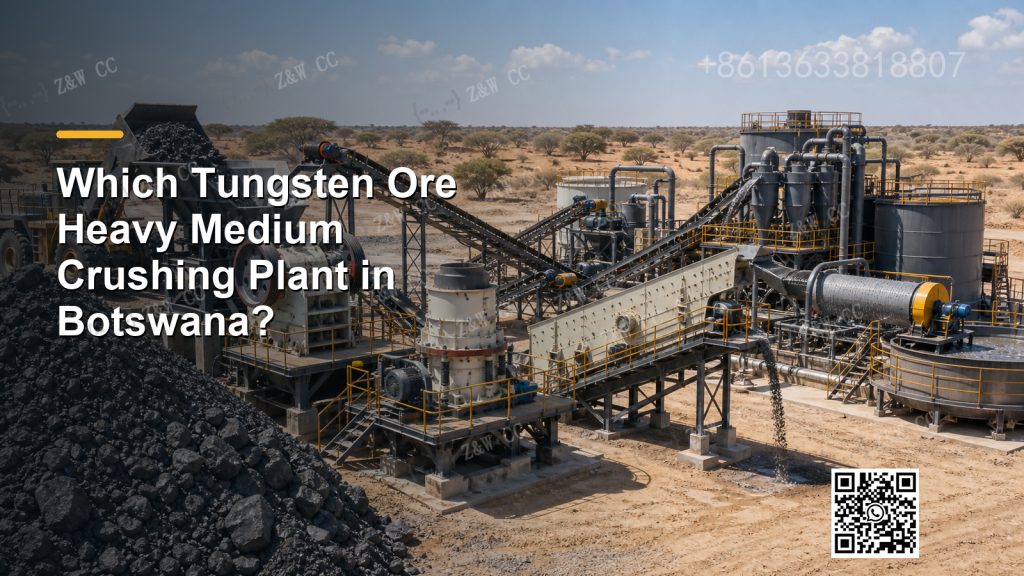
Run-of-mine tungsten ore up to 600 mm is reduced by a primary jaw crusher and a secondary cone crusher to 20-30 mm — the range where most scheelite and wolframite grains begin to liberate. A vibrating screen closes the circuit and returns oversize to the cone.
Heavy Medium Pre-Concentration Before Grinding
The -30 +1 mm fraction enters a dense media cyclone (or a drum separator for coarser feed), where a ferrosilicon suspension at a cut-point density of 2.7-3.0 g/cm³ rejects barren gangue. The heavy sinks carry the tungsten values to the mill; the light floats become backfill or by-product aggregate. Waste rejection at this stage lifts mill feed grade and lowers downstream energy and reagent use.
HMS Flow vs. Direct Grinding
| Parameter | HMS Pre-Concentration Flow | Conventional Direct Grind |
|---|---|---|
| Crushing stages | Jaw + cone to 20-30 mm | Jaw + cone to 20-30 mm |
| Waste rejected before mill | 25-40% of ROM mass | Minimal |
| Mill feed grade | Raised by pre-concentration | ROM grade |
| Water circuit | Closed-loop with media recovery | Standard |
| Relative plant capex | +15-25% (DMS module) | Baseline |
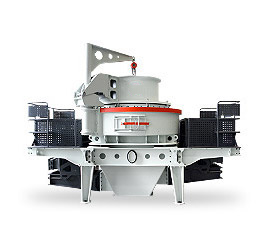
Note the difference from an aggregate plant: a sand-and-gravel operation would add a VSI sand maker and washing to shape 0-5 mm product, while a tungsten line stops at the cone and feeds a grinding mill. The HMS floats, however, can be crushed further into construction aggregate if local demand exists.
Local Adaptation for Botswana
Water: Closed-loop circuits with a thickener and filter press typically recover about 90% of process water; ferrosilicon media is reclaimed with magnetic separators instead of reporting to tailings.
Power: For sites beyond the BPC grid, a diesel or diesel-hybrid generator plan should be included in the quotation, with motors sized for stable operation under fluctuating voltage.
Logistics and permitting: Skid-mounted modules cut assembly time in remote areas, and an environmental impact assessment under Botswana’s Mines and Minerals Act is normally required before commissioning.
Frequently Asked Questions
Which crusher suits tungsten ore in Botswana?
A jaw crusher for primary reduction plus a cone crusher for secondary crushing handles hard, abrasive scheelite and wolframite, producing 20-30 mm feed for pre-concentration.
Why add heavy medium separation to a tungsten crushing plant?
It rejects barren waste at coarse size before grinding, raising mill feed grade and cutting energy, media, and reagent costs — important when ROM tungsten grades are low.
What feed size does a dense media cyclone accept?
Dense media cyclones typically treat 30-1 mm material; coarser feed suits a drum separator. Proper screening ahead of the cyclone protects media recovery efficiency.
Is a tungsten heavy medium plant water-intensive?
It uses water for media washing and gravity concentration, but closed-loop circuits with a thickener recover about 90% — a decisive factor in Botswana’s dry climate.
Get Your Custom Tungsten Plant Design
The right tungsten ore heavy medium crushing plant for Botswana balances ore hardness, water availability, and site power. Our engineering team can prepare a tailored process flow, equipment drawings, and a project quotation for your deposit. Use the online consultation widget on the right to start the discussion.
zmj
Author & industry specialist at ZWCC Mining & Crushing
.jpg)
.jpg)