A rising return conveyor load in a basalt aggregate circuit does not automatically justify a larger cone crusher. The returning material may contain genuine oversize that needs another crushing pass, correctly sized stone that failed to pass the screen, or a mixture of both. These cases require different investments. Before requesting more installed power, engineering and procurement teams should establish a consistent circuit mass balance, sample the return stream, and check the screen and crusher under comparable operating conditions. This article sets out a practical review for a cone crusher feeding a sizing screen, with oversize returned to the cone feed. It explains which observations support screen work, feed control changes, or a crusher capacity review, and what evidence to include in an equipment inquiry. The objective is more compliant product leaving the circuit, with a clear account of where existing capacity is being consumed.
1. Define the circuit boundary before measuring return load
For this review, fresh basalt enters the cone feed hopper, joins the returning screen oversize, passes through the cone, and then reaches the sizing screen. Screen undersize leaves as product. This boundary matters: a plant that sends fresh feed to the screen first needs a different accounting layout. Record any bypasses, separate product withdrawals, spillage, and changes in stock held in bins before comparing results.
Use one dry-solids basis and one time interval for all measured streams. Define circulating load as return dry tonnes divided by fresh-feed dry tonnes, multiplied by 100. The cone handles fresh feed plus return, while the product stream represents material leaving the selected boundary. Under stable conditions, without other outlets or accumulating inventory, product and fresh-feed mass should approximately balance. A large mismatch is a reason to check measurements and the boundary before diagnosing equipment.
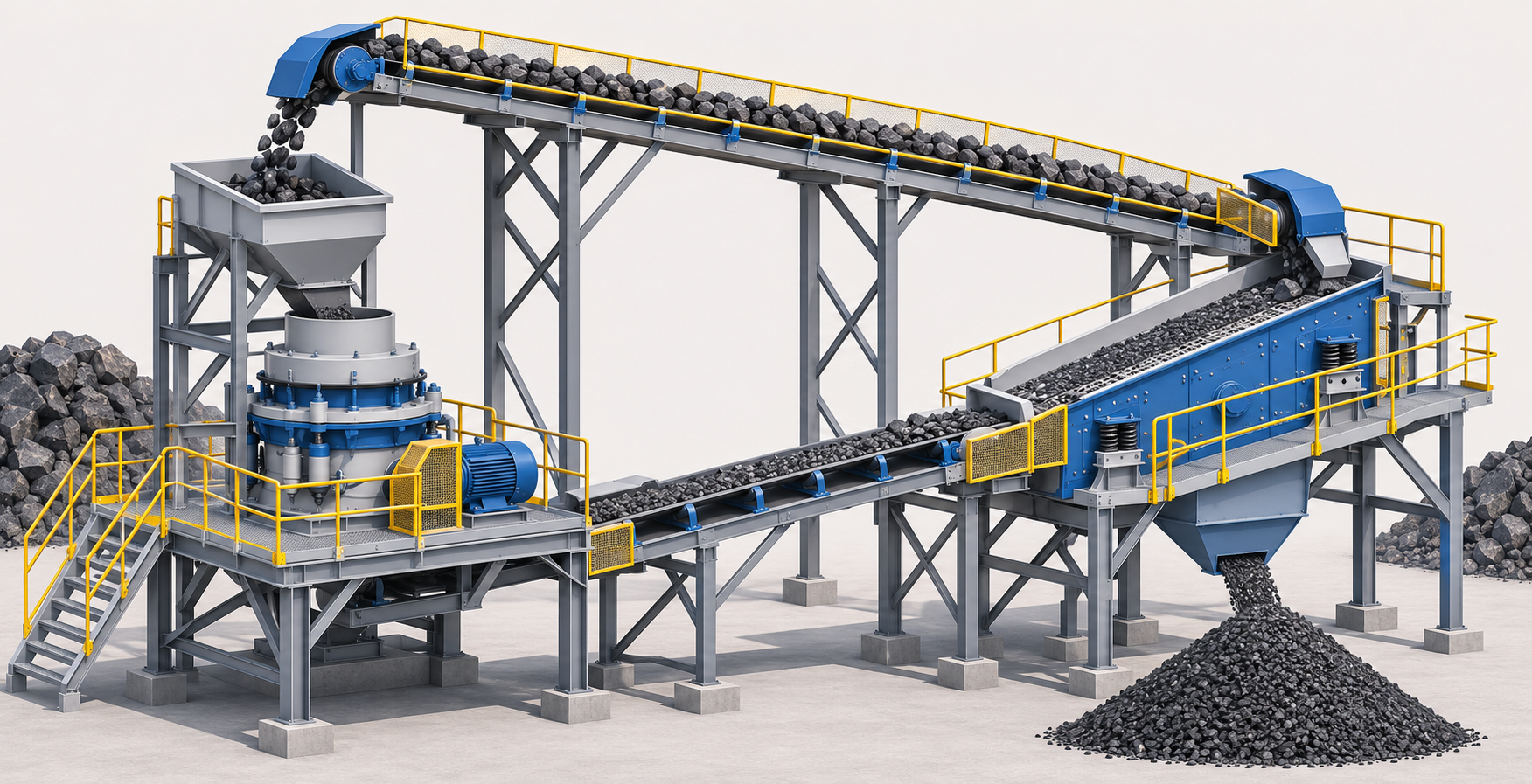
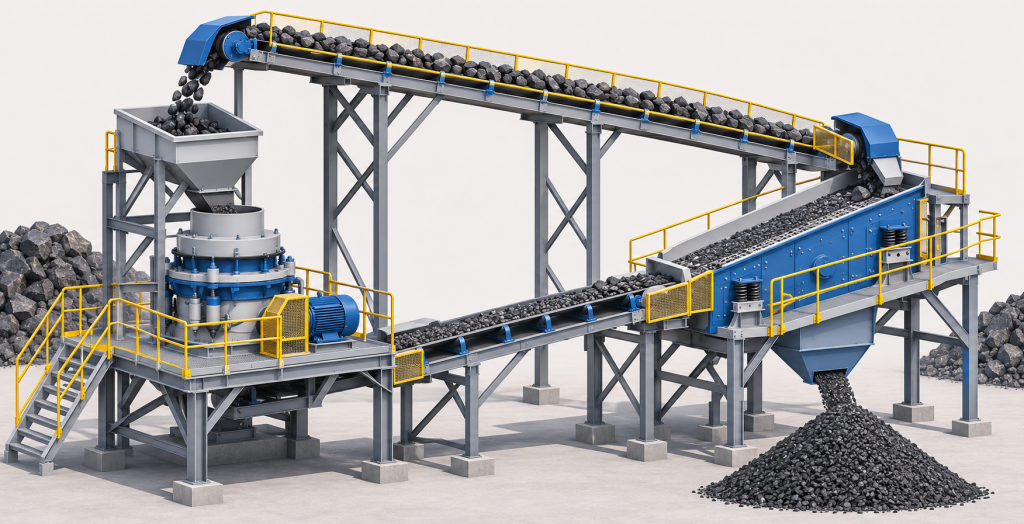
Original conceptual illustration: cone crushing with a sizing screen and an oversize return path. Equipment arrangement is illustrative, not a project installation or dimensional design.
Use calibrated belt measurements or an approved sampling and weighing procedure. Collect operating data from a safe location; physical access to chutes, belts, and screen decks requires isolation under the site’s procedures. Motor current trends can reveal changes, but they do not replace mass measurements.
2. Separate genuine oversize from misplaced product
Sample the return stream over a representative period and sieve it against the intended separation size. Compare its size distribution with the screen feed and product. A return stream rich in particles already below the intended cut points toward a separation problem. A return dominated by larger particles calls for closer examination of the crusher discharge distribution, chamber selection, and operating setting. Neither finding alone proves that a particular machine is undersized.
On the screen, check whether material reaches the full deck width or forms a deep strip along one side. Inspect for pegged openings, damaged media, overloaded transfer points, and restrictions at discharge. Near-size particles can be particularly difficult to separate; the percentage close to the aperture matters as well as total feed tonnage. Changing the aperture solely to reduce return can also change the delivered product grading, so confirm the specification before making that change.
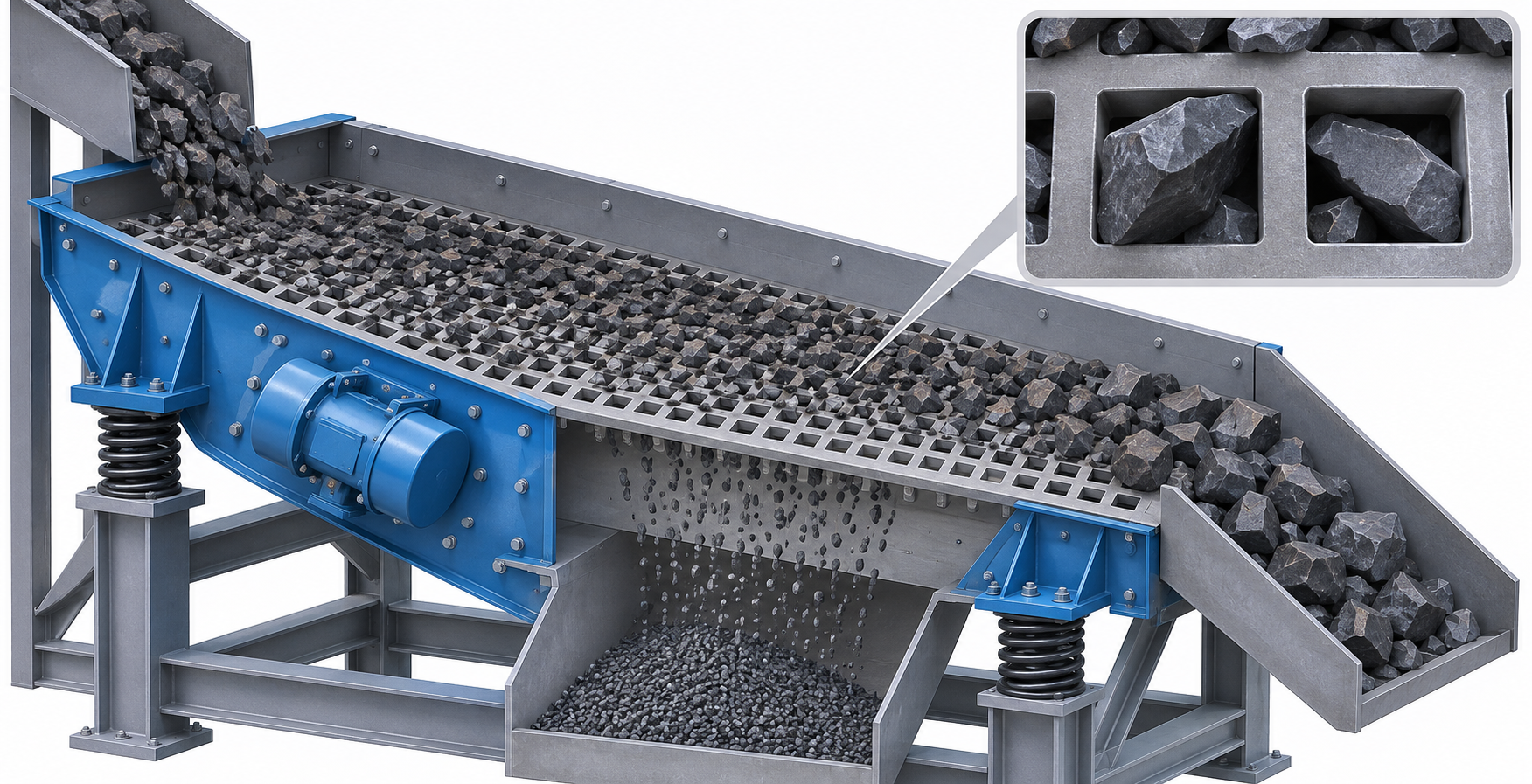
Original conceptual illustration: passage of smaller basalt particles through a sizing deck, with an inset showing pegged apertures. Particle sizes and deck geometry are schematic.
3. Use the observations to choose the next intervention
The following qualitative guide is intended for a site review. It does not establish a universal return-load limit or predict a capacity gain.
| Observed condition | Evidence to collect | First engineering review | Procurement implication |
|---|---|---|---|
| Return contains substantial material below the intended cut | Sieve analyses of screen feed, return, and product; deck coverage observations | Feed distribution, available open area, bed depth, and screen duty | Assess media, feedbox, or screen capacity before buying a larger cone |
| Return is mainly genuine oversize | Crusher discharge grading, verified setting, liner condition, and power trend | Chamber suitability and achievable reduction for the sampled basalt | Request a material-specific crusher and circuit assessment |
| Return surges while fresh feed fluctuates | Synchronized feed, return, bin-level, and power trends | Surge storage, feeder control, and transfer restrictions | Define the required control and storage improvements |
| Return increases as the screen deck becomes obstructed | Isolated deck inspection and media condition records | Pegging, contamination, media selection, and maintenance access | Specify suitable media and access rather than an assumed power increase |
| Compliant product remains low after verified corrections | Repeatable mass balance under a documented feed and product specification | Capacity of the complete cone-screen-conveyor loop | Compare coordinated circuit upgrades using the same duty basis |
4. Review cone operation together with the screen
A basalt label alone does not define the crushing duty. Submit representative grading, moisture, bulk density, and available abrasion and crushability information. Mineralogy and weathering can vary within a deposit. Keep those variations visible in the assessment rather than assigning a throughput from rock name alone.
Check feed distribution into the cone, the installed chamber, liner wear, the verified closed-side setting, and the freedom of the discharge path. Follow the machine manufacturer’s operating envelope. A tighter setting may change the discharge grading while also changing power demand and throughput; its effect on saleable output must be checked across the loop. Likewise, a larger cone can simply transfer the bottleneck to an existing screen or return conveyor.
This circuit-level approach is consistent with the crushing and screening handbook’s discussion of crusher capacity, which treats feeders, material distribution, discharge handling, and closed-circuit screens as part of crusher performance. Model-specific capacity tables still require the actual application conditions.
5. Request quotations against compliant product output
Prepare an inquiry with the circuit drawing, fresh-feed grading range, required product grading, measured return distribution, operating hours, and restrictions on utilities and layout. Include the condition of the existing cone, screen media, and conveyors. When reviewing crushing and screening equipment options, ask which item is expected to constrain the proposed duty and which assumptions support the selection.
Evaluate proposals on net compliant product leaving the agreed boundary, with internal circulating tonnes stated separately. Require suppliers to identify the feed envelope, included equipment, measurement method, and acceptance conditions for any performance commitment. Compare maintenance access, wear-part provisions, and the implications for existing structures as well as nominal capacity.
Once the measurements are assembled, send the circuit data for an equipment review. The useful decision is whether to restore separation, stabilize feed, or increase a demonstrated capacity constraint. A documented before-and-after mass balance makes that decision reviewable without inventing project results or assuming that more crusher power must produce more finished aggregate.
mj
Author & industry specialist at ZWCC Mining & Crushing